Did you know that in every UPSC Prelims paper, over 15 to 20 questions come directly from geography? However, the key question is: are you approaching your studies effectively, or do you find yourself feeling confused and overwhelmed?
For example, a common myth that is found among the aspirants is that physical geography and Indian geography are two separate subjects. The real key to mastering GS Geography is to see them as two sides of the same coin. Think of preparing for geography like building a house. First, you need a strong foundation, which is your physical geography. Then, you build the walls and rooms, which represent Indian geography. Finally, you add the electrical wiring that connects everything, which is your knowledge of current affairs.
FYI, last prelims (2025), nearly 70% of the geography questions could have been answered correctly just by having a strong command over four key topics. Let’s start building your understanding, step by step.
Pyramid of Priority

The UPSC CSE Geography Prelims (2021–2025) questions show a clear “Pyramid of Priority” for topics based on the weightage and the number of questions asked each year. Focusing on high-yield topics is essential for effective and strategic preparation. Here’s a detailed analysis, combining both the given priority scheme and real question data from 2021–2025.
Tier I: High Priority (60% Focus)
These topics contribute the largest number of questions and should be the mainstay of preparation.
Topics and Number of Questions (2021–2025):
- Climatology: 16
- Mapping – World Geography: 16
- India Physical Geography: 8
- Geomorphology: 6
- Resources: 8
- Agriculture: 8
Importance: On average, more than half the geography questions each year are from these areas. For example, in 2024, approximately 20 geography-related questions were asked; over 10 came from these high-priority zones. Similarly, in 2025, approximately 14 questions were asked directly from high-priority topics.
Question Examples:
Climatology “Without the atmosphere, the temperature would be well below the freezing point everywhere on the Earth’s surface.” Which of the statements given above are correct? (2025)
“With reference to ‘Coriolis force,’ which of the following statements is/are correct?” (2023)
Mapping-World: Consider the following water bodies: I. Lake Tanganyika II. Lake Tonlé Sap III. Patos Lagoon; through how many of them does the equator pass? (2025)
“The longest border between any two countries in the world is between (a) Canada and USA” (2024)
India Physical Geography: “Which one of the following is the best example of repeated falls in sea level, giving rise to present-day extensive marshland? (d) Rann of Kutch” (2023)
Geomorphology: “Which of the following are the evidences of the phenomenon of continental drift?” (2024)
Strategy: These six topics should receive the bulk of your revision time and question practice, as they reflect the core of the UPSC’s question pattern.
Tier II: Medium Priority (30% Focus)
These areas are consistently present, but their share is lower.
Topics and Number of Questions (2021–2025):
- Current Affairs Geography: 5
- World Vegetation: 4
- India-Transport & Communication: 3
- Mapping – India: 3
Importance: Around one-third of the questions are from here. These topics often require connecting static concepts to current events or contemporary developments.
Question Examples:
World Vegetation: “Consider the following trees: How many of the above are deciduous? (2024/23)”
Current Affairs: “Consider the following statements about turmeric during the year 2022–23: … Which of the statements given above are correct?” (2025)
Mapping-India: “With reference to the Himalayan rivers joining the Ganga downstream of Prayagraj from west to east, which one of the following sequences is correct?” (2024)
With reference to India, Didwana, Kuchaman, Sargol and Khatu are the names of: (2021)
Strategy: Allocate about 1/3 of your time to these. Use current affairs resources, government reports, and updated atlases to capture the dynamic aspect of these questions.
Tier III: Low Priority (10% Focus)
Prepare these for maximizing overall accuracy, but they form the smallest proportion of questions.
Topics and Number of Questions (2021–2025):
- Oceanography: 2
- Remote Sensing & GIS: 2
- Population Geography: 2
- Political Geography: 2
Importance: Only about 10% of geography questions come from these; skipping them can cost marks, but over-preparing here is not strategic.
Question Examples:
Oceanography: Consider the following statements. The Global Ocean Commission grants licenses for seabed exploration and mining in international waters….(2021)
Population Geography: “The total fertility rate in an economy is defined as …” (2024)
Remote Sensing & GIS: Which one of the following countries has its own satellite navigation system? (2023)
Final Strategy:
Review: basic principles and solve 2–3 years’ previous questions for these topics. Pay attention, but invest time wisely.
Prioritize: Focus first on Tier I, then Tier II, ensuring solid fundamentals. Use solved questions (2021–2025) for regular practice.
Revise with Examples: For every topic, attempt 2–3 years of actual Prelims Qs to understand pattern variations.
Integrate Current Affairs: Link static knowledge (Tier I/II) with dynamic/current issues for maximum score.
By following this pyramid-based preparation, aspiring candidates can maximize both scoring potential and revision efficiency for geography in the UPSC Prelims.
Macro & Micro Topics
Physical Geography
Origin and Evolution of the Earth
- Early & Modern Theories: Big Bang Theory, Nebular Hypothesis, Planetesimal & Tidal Hypotheses
- Star Formation, Solar System, Planetary Differentiation
- Geological Time Scale
Evolution of Earth’s Lithosphere, Atmosphere, and Hydrosphere
- Earth’s Movements and Coordinates
- Latitude and Longitude: Parallels & Meridians
- Motions of the Earth: Rotation, Revolution, and their effects
- Inclination of Earth’s Axis
- Local and Standard Time, International Date Line
- Eclipses: Solar & Lunar
Geological Structure
- Interior of the Earth: Crust, Mantle, Core, Seismic Discontinuities
- Rocks: Igneous, Sedimentary, Metamorphic; Rock Cycle
- Minerals: Types (Metallic, Non-metallic), Physical Properties, Major Mineral Groups
Distribution of Continents and Oceans
- Plate Tectonics: Continental Drift Theory, Sea-Floor Spreading, Types of Boundaries, Ocean Floor Features: Continental Shelf, Abyssal Plains, Mid-Oceanic Ridge, Trenches
- Earthquakes: Types, Causes, Shadow Zones, Seismic Waves, Indian Earthquake Zones
- Volcanoes: Types, Distribution (Ring of Fire, Mediterranean, etc.), Effects
- Tsunami: Causes, Mechanism, Impact Zones
Geomorphic and Exogenic Processes
- Weathering: Physical, Chemical, Biological
- Mass Movements: Landslides, Slumps, Rockfalls
- Erosion and Deposition by Running Water, Wind, Glaciers, Waves
- Landform Development: Cycle of Erosion (Davis/King Penck)
- Karst Topography, Glacial Landforms, Aeolian, Coastal
Climatology (World Weather and Climate)
Atmosphere Composition & Structure
- Layers: Troposphere, Stratosphere, Mesosphere, Thermosphere
- Composition: Gases, Water Vapor, Dust
Solar Radiation & Heat Balance
- Insolation and Albedo
- Heat Budget, Temperature Distribution, Inversion
- Adiabatic Lapse Rate, Latent Heat, Greenhouse Effect
Pressure, Winds, and Circulation
- Pressure Belts, Wind Systems
- Planetary, Trade, Westerlies, Polar Winds
- Jet Streams, Rossby Waves
- Monsoons, Local Winds (Loo, Chinook, Mistral)
Humidity and Precipitation
- Forms: Dew, Frost, Fog, Clouds
- Rainfall Types: Conventional, Orographic, Cyclonic
- Cyclones: Tropical & Temperate, ENSO, La Niña
World Climates
- Köppen Classification
- Equatorial, Tropical, Mediterranean, Temperate, Desert, Polar
Oceanography
- Ocean Relief: Major and Minor Features (Ridges, Seamounts, Guyots, Trenches)
- Temperature and Salinity Distribution
- Ocean Currents: Cold & Warm, Gulf Stream, Kuroshio, Oyashio
- Waves and Tides: Formation, Types, Importance
- Marine Resources, Coral Reefs, Marine Pollution
Biogeography
Soils
- Soil Formation, Classification, Profiles
- Soil Erosion and Conservation
Vegetation
- Biomes and Natural Vegetation Distribution
- Ecosystem Functioning, Biodiversity Hotspots
- Wildlife Distribution, Conservation Efforts
Economic Geography
Mineral and Energy Resources
- Distribution of Coal, Petroleum, Natural Gas, Iron, Manganese, Bauxite, Uranium
- Renewable and Non-conventional Energy Sources
Industries
- Iron & Steel, Textile, Cement, Paper, Chemical, Agro-based, and Automobile Industries
- Location factors and Industrial Regions
Agriculture
- Land Use, Cropping Pattern, Irrigation Types
- Major Crops and Conditions for Growth
- Green Revolution, Cropping Seasons
Transport
- Road, Rail, Air, and Waterway Networks
- Trade and Regional Development Corridors
Human and Social Geography
Population and Settlement
- Population Distribution, Density, Growth
- Urbanization, Demographic Transition
- Rural & Urban Settlement Patterns
Human-Environment Interaction
- Resource Utilization, Environmental Degradation, Disasters (Earthquake, Flood, Drought)
Indian Geography
Physiography
- Northern Mountains, Northern Plains, Peninsular Plateau, Coastal Plains, Islands
- India Drainage: Major River Systems (Himalayan & Peninsular Drainage)
- Important Lakes, Dams, Canals
Climate
- Mechanism of Indian Monsoon, Retreating Monsoon
- Local Winds, Cyclones, Seasonal Variations
- Distribution of Rainfall and Climatic Regions
Soils and Vegetation
- Alluvial, Black, Red, Laterite, Desert, Forest, Mountain soils
- Forest Types—Evergreen, Deciduous, Thorny, Montane
- National Parks, Biosphere Reserves, Wildlife Sanctuaries
Agriculture & Resources
- Cropping Seasons—Rabi, Kharif, Zaid
- Major Crops: Rice, Wheat, Sugarcane, Cotton, Jute
- Irrigation Systems, Groundwater Management
- Mineral and Energy Resource Distribution
- Industrial Regions: Mumbai-Pune, Chotanagpur, Tamil Nadu
Map-Based and Contemporary Topics
- Important Mountains, Rivers, Lakes, Cities, Ports, and Border Areas in News
- International Straits, Seas, Hotspots
Current Environmental Geography Issues
- Desertification, Deforestation, Coral Bleaching, Melting Glaciers
Mind Map of UPSC CSE Prelims Geography Syllabus
Connecting the Dots
For effective preparation, especially for new aspirants, a holistic and interdisciplinary approach to the syllabus is crucial. Isolated study of topics is insufficient. Instead, subjects must be examined through their natural and obvious linkages. For instance, the Indian monsoon, while listed under ‘India’s Climate,’ must be comprehensively understood by analyzing its connections to climatology, Indian agriculture, Rivers and disaster management. It can be very well understood with the help of the given mind map.
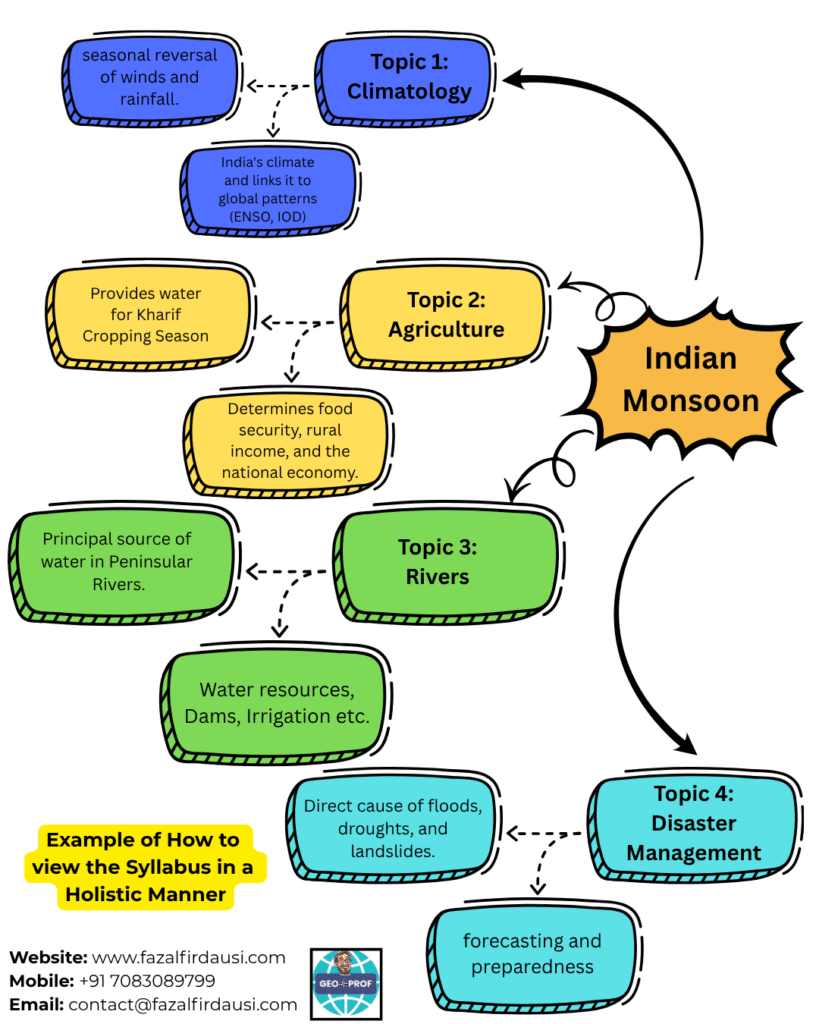
This method of integrated study ensures deeper understanding, better retention, and stronger analytical skills essential for examinations such as UPSC Civil Services.
Conclusion
Aspirants must remember that geography is about understanding patterns and connections, not just memorization. The journey to mastery begins with a single step. Now that you have the deconstructed syllabus to help you prepare, it’s time to start.